home
Tudor & colonial homes
Forest Hills Gardens and adjacent streets are known for Tudor revivals and colonials with slate roofs, stucco, and half-timbering. These are larger, often single-family homes with room for additions.
Housing stock, landmark and zoning rules, DOB permits, and realistic 2026 costs for kitchens, bathrooms, additions, and gut renovations in Forest Hills, Kew Gardens, and Briarwood.
Forest Hills is one of Queens' most architecturally distinctive neighborhoods. The housing stock ranges from Tudor revivals and stately colonials in Forest Hills Gardens to co-op apartment buildings along Queens Boulevard and quieter single-family blocks in Kew Gardens and Briarwood. That variety means renovation here can mean anything from a co-op kitchen refresh to a full-house gut and second-story addition.
A defining feature of this area is oversight. Forest Hills Gardens is a privately planned, landmarked community with its own design review, and even outside the Gardens, many homes sit within NYC historic-district or contextual zoning rules. If your property is landmarked, what you can change on the exterior — and sometimes visible interior elements — is restricted.
This guide covers the housing stock, the projects homeowners take on, permit and landmark realities, 2026 costs, and realistic timelines for remodeling in Forest Hills and the surrounding neighborhoods.
The building type shapes what a renovation can realistically achieve.
Forest Hills Gardens and adjacent streets are known for Tudor revivals and colonials with slate roofs, stucco, and half-timbering. These are larger, often single-family homes with room for additions.
Along Queens Boulevard and Austin Street, six- to seven-story pre-war co-ops dominate. Renovations here resemble Astoria's: board alteration agreements and shared plumbing stacks.
Forest Hills Gardens has private design review, and parts of the area fall under NYC landmark rules. Exterior changes — windows, roofs, facades — can require additional approvals.
Compared with northern Queens, many Forest Hills single-family homes sit on larger lots with yards, making additions, dormers, and backyard ADUs more feasible than in denser areas.
What Forest Hills homeowners actually take on.
High on the list across both the co-op and single-family stock. In the single-family homes, homeowners often combine a kitchen remodel with opening up the first floor.
Larger colonials and Tudors are good candidates for ground-up additions, second stories, and dormers to add living space — subject to zoning and, in the Gardens, design review.
Buyers of older colonials frequently gut and reconfigure the entire house — new layout, systems, and finishes — priced per square foot.
Restoring original slate roofs, windows, and stucco is common and, in landmarked areas, often required to match the historic character.
NYC Department of Buildings: Kitchens, bathrooms, additions, and gut renovations that touch plumbing, electrical, gas, or structure all require DOB permits. Structural and layout changes need a licensed architect or professional engineer to file plans. Additions also require zoning analysis for floor-area ratio (FAR), yard setbacks, and height.
Forest Hills Gardens design review: If your home is in the Gardens, the private community association reviews proposed exterior changes for compatibility with the planned community's character. This is a separate approval on top of DOB, and it applies to facades, roofs, windows, fences, and landscaping.
NYC landmarks: Properties within NYC landmark districts or designated individually need Landmarks Preservation Commission (LPC) approval for exterior work before DOB will issue permits. Interior changes are generally not landmark-controlled unless they affect a designated interior.
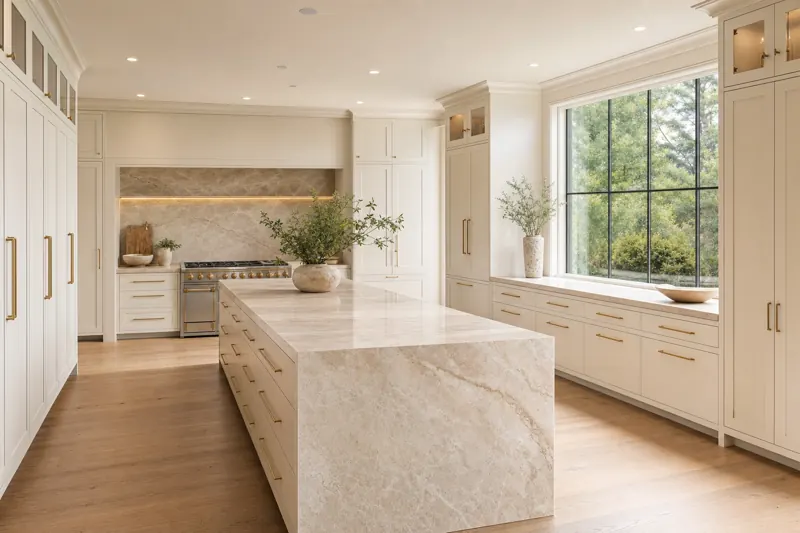
Forest Hills costs run the full range because the stock spans co-op apartments and large single-family homes. A kitchen remodel runs $45,000–$85,000 mid-range and up to $180,000+ for a luxury gut with custom cabinetry. See the Queens kitchen cost guide.
Bathroom remodels typically run $20,000–$40,000 standard and $45,000–$90,000+ for a spa-level bath. Home additions — a common project here given the larger lots — start around $150,000–$400,000+ for a dormer or second story; see the home additions cost guide.
Full-house gut renovations are priced per square foot, typically $200–$275/sq ft mid-range and higher for landmark-compatible finishes. Restoring slate roofs and original windows is a specialty cost that can exceed standard roofing budgets materially.
Single-family projects in Forest Hills tend to move faster on the approval side than co-op work (no board alteration agreement), but landmark or Gardens design review can add weeks. Plan 2–6 weeks for DOB permit filings and, if applicable, additional time for LPC or design-review approval.
Active construction timelines are similar to Queens norms: a kitchen 4–8 weeks, a bathroom 2–3 weeks, a full-house gut 8–16 weeks, and an addition 3–6 months depending on scope and foundation work.
Forest Hills Gardens is a privately planned community with its own design review. Separately, some properties fall under NYC landmark district rules. Check your property on the NYC Landmarks Preservation Commission map and, for the Gardens, with the community association. Landmark status mainly restricts exterior changes.
Often yes, if zoning allows it. NYC zoning controls floor-area ratio, yard setbacks, and height. If your planned addition exceeds those limits, you may need a variance from the Board of Standards and Appeals — a public hearing process with no guarantee of approval. In Forest Hills Gardens, exterior changes also need design review. See our home additions guide.
Yes, if the work changes plumbing, electrical, gas, or layout. A licensed architect or engineer files plans with the DOB for layout changes, and your contractor pulls the work permits. In a Forest Hills co-op, you'll also need a board alteration agreement before construction.
Gut renovations are priced per square foot — typically $200–$275/sq ft mid-range and $275–$400+/sq ft for luxury or landmark-compatible finishes. A 2,000 sq ft colonial can run $400,000–$800,000+ depending on systems, layout changes, and finish level. See the gut renovation cost guide.
Yes. Reading this guide and requesting an estimate are free. Queens Reno Guide is a referral service: when you request an estimate, we connect you with a licensed remodeling contractor serving Forest Hills and Queens. We may receive a referral fee from the contractor, at no cost to you.
Queens Reno Guide publishes local cost data and connects homeowners with licensed contractors across Queens, New York.
Tell us about your project and we'll connect you with a licensed, insured Queens contractor for a free, no-obligation estimate.
Thanks — we'll connect you with a licensed Queens contractor shortly. Keep an eye on your email and phone.